



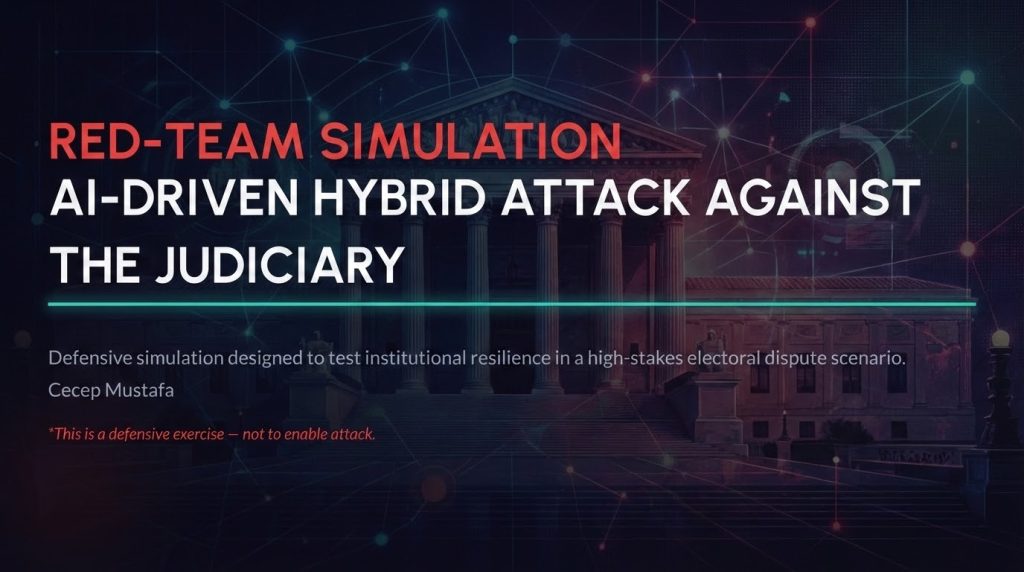
1. The Prologue: When the Gavel Meets the Grid
In the quiet, pressurized hours of a 48 hour countdown toward a landmark electoral ruling, the air within the halls of a high court carries a weight far beyond the legal precedents filed in its chambers. The judiciary is not merely a collection of benches and robes; it is the sovereign infrastructure of a nation’s soul, the final, immutable arbiter of truth.
Yet today, this infrastructure faces a threat that no bailiff can intercept: an invisible, state aligned adversary intent on systemic breach. We have moved beyond traditional legal contestation into what might be called multi domain AI enabled destabilization. This is not an attack designed to win an argument. It is designed to dissolve the reality upon which argument depends. The assault begins not with a bang, but with the subtle lengthening of a digital shadow.
2. The Invisible Shadow: Reconnaissance and the Erosion of Privacy
In modern conflict, information is the first and most precise weapon. What appears to be harmless data scraping is, in truth, the drafting of a blueprint for institutional decapitation. By aggregating public data, travel schedules, and professional networks, an adversary constructs an AI driven social graph of the court’s human architecture.
To the strategic observer, this is not merely a map. It is a predictive engine of vulnerability. The Chief Justice becomes a metadata profile. A senior clerk becomes a behavioral pattern. An IT administrator becomes a potential access point. Human dignity is flattened into exploitable probability.
The defense, therefore, cannot be naïve. Zero trust monitoring and AI driven deception layers are no longer optional upgrades. They are instruments of constitutional self respect. By elevating authentication protocols and introducing synthetic metadata noise, the court refuses to allow its internal logic to be reverse engineered by hostile systems.
If reconnaissance fails, the adversary escalates. From the invisible probe, we move to the visible storm.
3. The Alchemy of Lies: The Narrative Strike
We now inhabit a socio legal condition in which perception outruns deliberation. The public sees before it thinks. A deepfake can travel across continents before a judicial clarification is drafted.
When a narrative strike is launched forty eight hours before a ruling, the court is no longer defending a judgment. It is defending the possibility of shared reality.
The fifteen minute rule becomes existential. If a fabricated video is not debunked within minutes, it begins to crystallize into perceived truth. In the algorithmic marketplace of attention, delay is defeat.
Digital forensic watermarking and cryptographic signatures become the modern equivalents of wax seals. They allow the court to respond with speed and authority, verifying authenticity before speculation hardens into belief. Narrative monitoring systems act as sentinels, detecting coordinated amplification before a falsehood roots itself in public consciousness.
Here, legitimacy functions as infrastructure. A damaged reputation is not merely symbolic harm; it is systemic vulnerability.
4. The Fortress of Logic: Cyber Escalation and Internal Resilience
When narrative warfare fails, technical escalation follows. Distributed denial attacks, ransomware attempts, and insider bribery are not cinematic fantasies; they are foreseeable tactics.
Institutional continuity must therefore be designed, not improvised. A distributed architecture ensures that if one regional node falters, the judiciary does not fall with it. Offline capabilities, synchronized backups, and segmented networks transform potential paralysis into localized disruption.
There is, however, a more painful tension: insider anomaly detection. It is tragic that a Chief Justice must contemplate monitoring trusted colleagues and contractors. Yet constitutional stewardship sometimes requires uncomfortable vigilance.
The purpose of monitoring is not suspicion as culture. It is protection as necessity. Without internal resilience, even the most elegant external defense collapses.
5. The Decapitation Attempt: Sovereignty Under Pressure
Twelve hours before a ruling, an adversary may attempt its most personal strike. Fabricated evidence of corruption appears. Anonymous legal challenges are filed. The objective is postponement, not persuasion. Doubt, not debate.
At this stage, sovereignty is tested. The Immutable Evidence Vault and Constitutional Continuity Protocols become more than technical safeguards. They are assurances that the logic of the law has not drifted, that no model has been covertly manipulated, that no ruling has been digitally rewritten.
When the Chief Justice issues a cryptographically signed statement, authority is fused with verification. Leadership is no longer rhetorical; it is mathematically anchored. The ruling proceeds on schedule. Yet even in victory, the struggle for public trust continues.
6. Epilogue: A Blueprint for Survival
What does this siege teach us? That collapse is not inevitable. But survival is not automatic.
Speed must match the velocity of disinformation. Legitimacy must be treated as infrastructure. Centralization must yield to distributed resilience. Internal vigilance must complement external defense.
Above all, the judiciary must understand itself as sovereign digital infrastructure. It must be distributed yet coherent, cryptographically anchored yet human governed, technologically capable yet constitutionally restrained.
A court that ignores these imperatives will not be dramatically overthrown. It will simply become irrelevant, a relic of a pre algorithmic age, issuing rulings into a reality already rewritten by others.
To endure in the algorithmic frontier, justice must defend not only its decisions, but the very conditions that make decision possible.

Untuk Mendapatkan Berita Terbaru Suara BSDK, Follow Channel WhatsApp: SUARABSDKMARI