



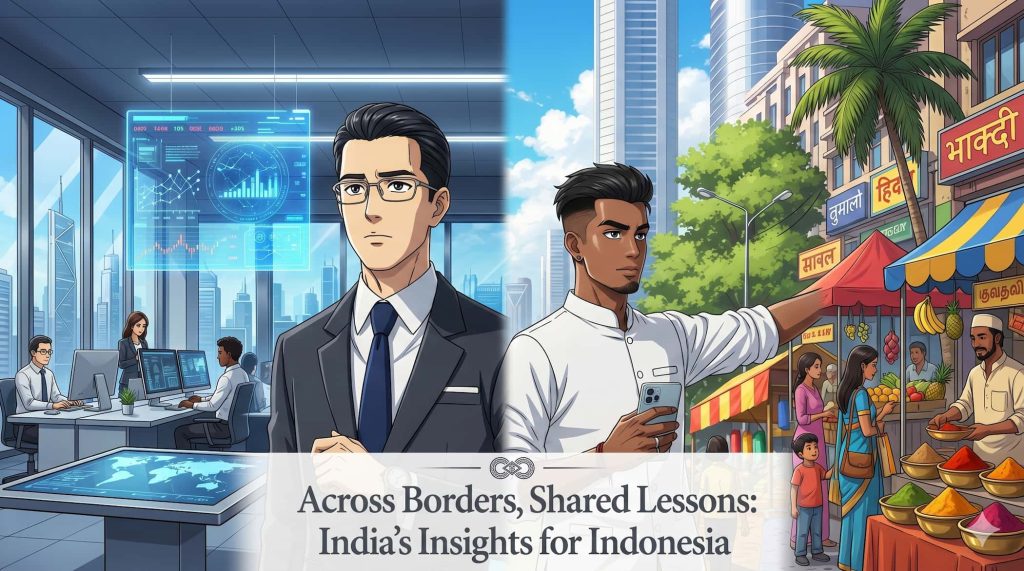
There are moments in a nation’s journey when it must pause, not to doubt itself, but to ask a deeper question: what truly binds us together? The idea of Bela Negara, defending the nation, has long been framed as duty, even obligation. Yet, perhaps the more urgent task today is to reimagine it as something lived, felt, and practiced in the quiet routines of everyday governance.
Indonesia stands at such a crossroads. As the vision of Golden Indonesia 2045 approaches, mirroring in ambition what others call long term national renewal, the challenge is no longer merely strategic alignment on paper. It is human alignment, within the very apparatus meant to serve the people. And here lies an uncomfortable truth: the gap is not simply technical or procedural; it is deeply social. A striking deficiency persists in what might be called the “glue competency”, the ability of state actors to genuinely unify, empathize, and connect.
It is telling that while training conformity appears nearly complete, the essence of national cohesion lags far behind. One might say we have learned how to follow systems, but not yet how to embody purpose. This is not a failure of policy alone; it is a reflection of how institutions often prioritize compliance over consciousness.
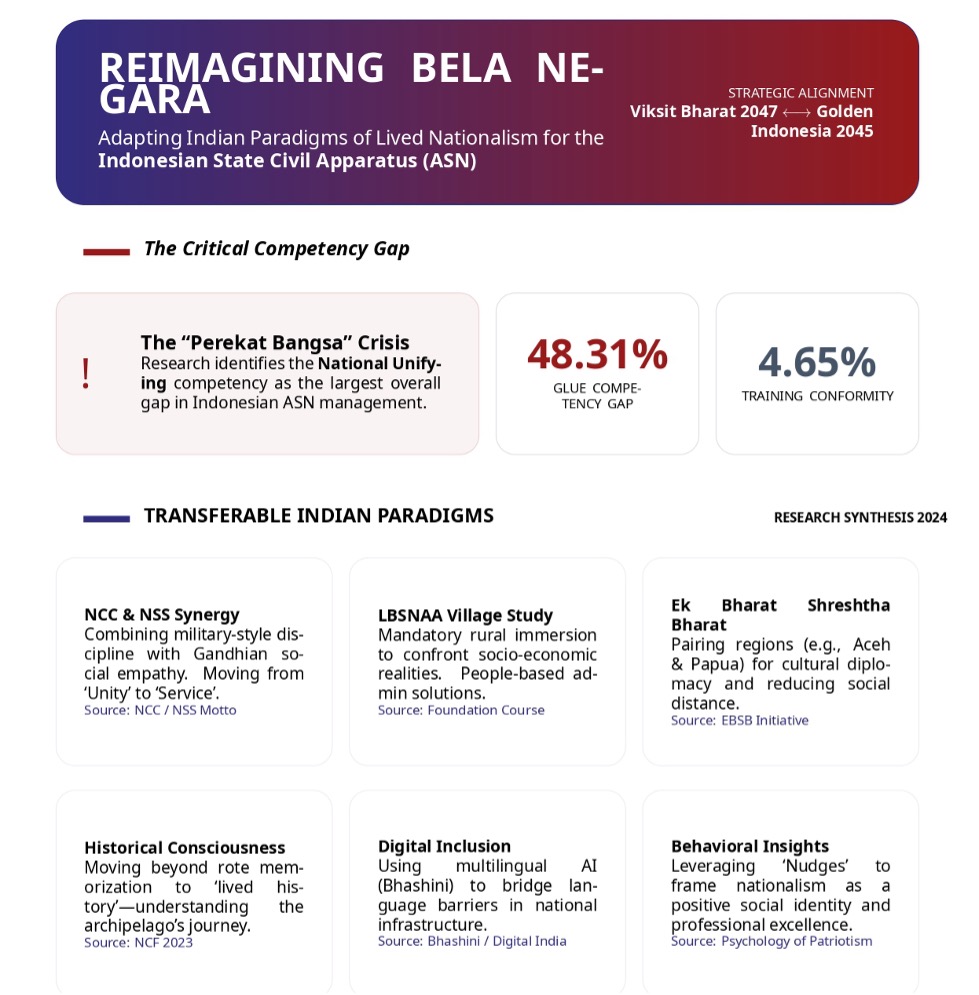
Looking outward, one finds inspiration in unlikely parallels. India, for instance, offers not a perfect model, but a living laboratory of how nationalism can be practiced rather than preached. Programs that blend discipline with social empathy remind us that unity is not forged through slogans but through service. Rural immersion initiatives reveal a simple yet profound truth: governance detached from lived realities risks becoming hollow. Cultural exchange efforts, meanwhile, show that reducing distance, whether geographic or psychological, can transform diversity from a challenge into an asset.
What stands out most is the shift from memorizing history to experiencing it. When individuals see themselves as participants in an ongoing national story, rather than passive recipients of it, a different kind of patriotism emerges, one that is less performative and more authentic.
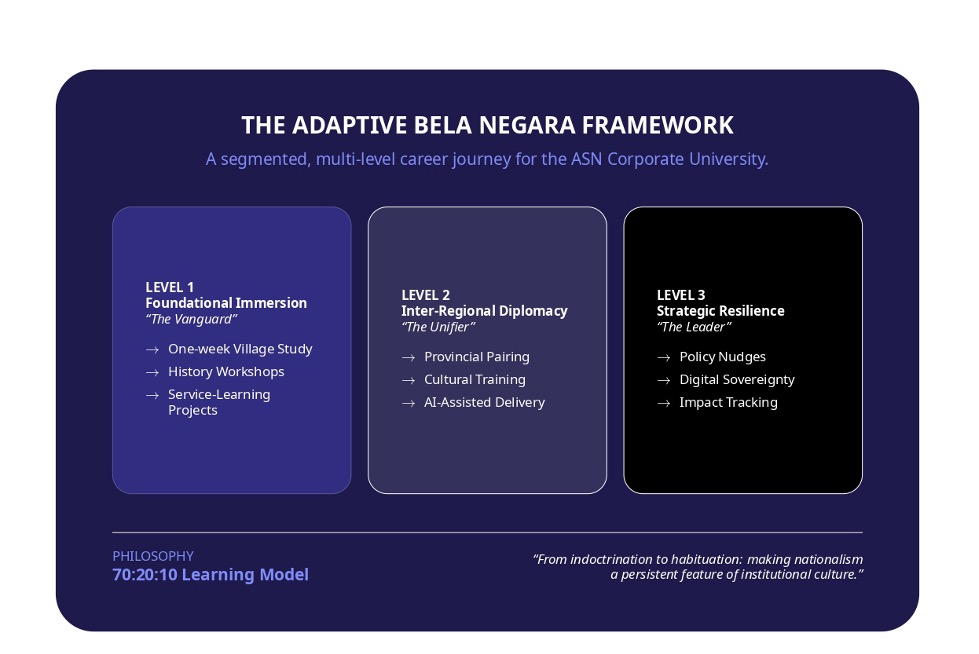
This raises an important question for Indonesia: can nationalism be taught, or must it be cultivated? The answer likely lies somewhere in between. Policies can create the structure, but it is repeated experience, habituation, that shapes identity. This is where the proposed multi level framework becomes compelling. By guiding civil servants through stages, from immersion to diplomacy to leadership, it attempts to transform nationalism from an abstract ideal into a professional ethic.

Yet, frameworks alone are not enough. Without a philosophical shift, they risk becoming just another checklist. The real transformation begins when nationalism is no longer seen as indoctrination, but as a lived practice embedded in institutional culture. A village visit is no longer a requirement, it becomes a moment of confrontation with inequality. Cultural training is no longer symbolic, it becomes a bridge across difference. Even digital tools, often viewed as neutral, take on ethical significance when used to include rather than exclude.
There is also a subtle but powerful role for behavioral insight here. People rarely change because they are told to; they change because environments make new behaviors feel natural, even desirable. If national identity can be reframed as a source of pride in professional excellence, not just rhetoric, it may quietly reshape how public servants see themselves and their work.
In the end, the question is not whether Indonesia can adopt ideas from elsewhere, but whether it can adapt them meaningfully. Every nation must write its own narrative. The danger lies not in borrowing, but in borrowing without reflection.
To reimagine Bela Negara is, ultimately, to reimagine citizenship itself, not as a static label, but as an evolving practice. It asks each individual within the state: Are you merely part of the system, or are you part of the story?
And perhaps that is where real national strength begins, not in grand declarations, but in the quiet, persistent effort to become the kind of society we claim to be.
Untuk Mendapatkan Berita Terbaru Suara BSDK, Follow Channel WhatsApp: SUARABSDKMARI