



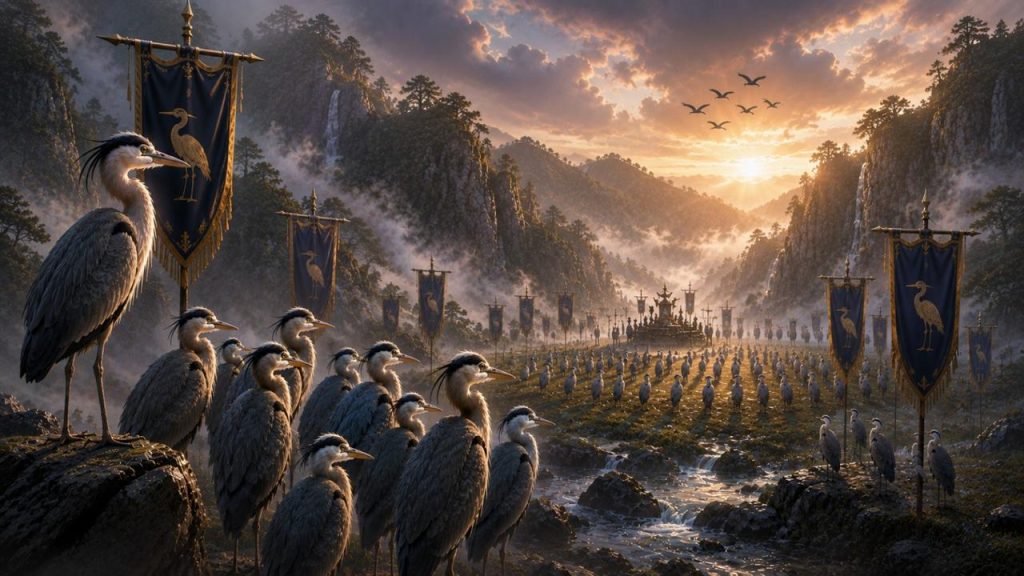
For decades, young herons have been destined to protect the rivers and lakes of the cloud forest. Before they can be considered capable of performing their duties well, however, young herons must undergo training and be tested. Only after passing this training can a young heron take on the title “Heron” and drop the word “Young.”
The culmination of this training takes place in a valley flanked by towering rocky hills, where a place called Deep Raven Valley stands. Young herons arrive there when the mist season is at its peak, to be forged before being released to guard the rivers, lakes, and swamps across the misty forests. However, the journey to Deep Raven Valley does not actually begin in the valley itself. The Deep Raven Valley is the eleven-day culmination of several months of training for the young herons. This year’s training in Deep Raven Valley was held twice: during the first mist season and the second mist season of the year. The young herons were divided into several flocks.
Prior to this, the young herons undergo preliminary training with materials sent via carrier pigeons by the Albatross Committee, which serves as their instructor. During this time, young herons do not meet the Albatross Committee, the Eagle Committee, or even fellow young herons face-to-face.
Within the Eleventh Flock, a young heron named Karu was appointed as the flock leader. Karu had little experience leading, let alone experience with physical precision and formation readiness. However, as his ancestors had taught him, Karu closed his eyes and exhaled, recalling the advice his ancestors had given him before embarking on a new challenge: “May this be a new lesson and may it bring new benefits to me and others.”
At the Deep Raven Valley, the Eleventh Flock received training from the Eagle Committee and the Albatross Committee. The training by the Eagle Committee made the Eleventh Flock truly experience the rigor of discipline under the guidance of the Eagle Guardians, who served as physical and mental discipline trainers. Meanwhile, the Albatross Committee provided instruction and led discussion sessions regarding the laws of natural balance in the cloud forest.
All flocks were required to assume a ready stance and prepare their wings even before the sun was clearly visible on the horizon. Various formation drills were taught by the elder herons and the Eagle Committee.
On the way to the various training locations in Deep Raven Valley, their footsteps had to be in unison on the cold rocky ground; sometimes, the rocky ground was even covered by a fairly strong stream that submerged the young herons’ feet halfway. Young herons who made mistakes in the formation’s rhythm had to be prepared to face reprimands from the elder herons or the Eagle Committee. In fact, many young herons only realized how nervous they became when asked to speak loudly in front of other flocks.
Meanwhile, the Albatross Committee explained an ancient manuscript containing various wisdom or lessons to be drawn from the legends of the former animal kingdom in the mist forest. The current dynamics of the changing balance of order and leadership in the mist forest were also the subject of an engaging discussion led by the Albatross Committee.
The classroom atmosphere under the Albatross Committee’s guidance was not always filled with manuscripts and serious discussions, including in the Eleventh Flock’s class. On some occasions, the Albatross Committee in the Eleventh Flock’s classroom asked the young herons to share their thoughts in front of the other flocks through various creative and exciting methods. At first, the young herons expressed their thoughts in soft, hesitant voices. However, it didn’t take long for voices to start emerging one by one until the sharing of opinions was presented through group singing or bursts of laughter by the young herons.
At the first class meeting with the Albatross Committee, the Albatross Committee asked Karu to lead the Eleventh Flock in creating a unique call pattern that would set them apart from other flocks. Karu invited members of the Eleventh Flock who had ideas to demonstrate them in front of the class. For such purpose, the Eleventh Flock decided to combine their various ideas for the call pattern. Karu, as the flock leader, tried to memorize all the rhythms and movements in a short time. Karu stood in front of the flock and said softly: “This is my weakness; my voice cannot go as loud or as strongly as some of yours, for this is how my beak has been made, and new call rhythms or lyrics sometimes escape my memories too fast, so please help me. Don’t let me lead the call, or at the very least, there must be two of us, one other person besides me.”
The days at Deep Raven Valley passed quickly. During the ceremony featuring a large formation of all flocks, many herons from the Eleventh Flock were seen at the front of the field acting as standard-bearers or ceremonial officers. There were also members of the Eleventh Flock who acted as one of the leaders of the call rhythm among the flocks. Furthermore, among the flocks, Karu noticed that the Eleventh Flock appeared to remain present with a complete formation from the beginning to the end of the training at Deep Raven Valley.
By the closing ceremony, the young herons of the Eleventh Flock, who had initially only known each other through carrier pigeon letters, had grown close to one another. For a moment, Karu looked at the young herons of the Eleventh Flock with a sense of gratitude for the bonds they had formed along the way. Before flying away, Karu simply bowed his head and recalled his ancestors’ advice upon completing a new experience: “Please forgive any mistakes I may have made along the way, and thank you.”

Untuk Mendapatkan Berita Terbaru Suara BSDK, Follow Channel WhatsApp: SUARABSDKMARI