



1. Prologue: Bridging Law and Humanity
For decades, Indonesia’s legal system has been characterized by rigid statutes, often functioning as an automated, retributive framework where the mechanics of judgment overshadowed the human reality of the cases before the court. The enactment of Supreme Court Regulation (PERMA) No. 3 of 2026 marks a transformative shift. Grounded in Article 246, paragraph (4) of Law No. 20 of 2025 (the Criminal Procedure Code), this regulation acknowledges that the law is not an end in itself, but a servant of justice. By institutionalizing Putusan Pemaafan Hakim (Judicial Pardon), PERMA No. 3 of 2026 introduces a “legal conscience,” bridging the gap between statutory formality and the complexities of human life.

2. Defining Mercy: More Than an Acquittal

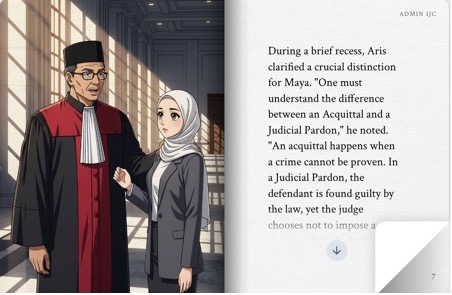
A Judicial Pardon is often misunderstood as an acquittal (vrijspraak), yet they are philosophically distinct. An acquittal is a declaration of innocence—a statement that the state has failed to prove its case. A Judicial Pardon, however, is a sophisticated moral compromise. Under Article 1, a pardon applies when the court finds the defendant guilty, yet determines that the state should refrain from imposing a sentence. It preserves the moral record of wrongdoing while suspending the state’s punitive power.

A Judicial Pardon is defined by three pillars:
- Proven Guilt: The court establishes that the act occurred and the defendant is responsible.
- Triviality or Mitigating Context: The offense is categorized as “light,” or the defendant’s circumstances warrant significant empathy.
- Absence of Punishment: The judge declines to impose a sentence or an “action” (tindakan).
By empowering the judge to exercise mercy, this regulation elevates the bench from a mere “mouthpiece of the law” to an arbiter of true justice, asserting that legal certainty must be tempered by the utility and proportionality of punishment.

3. The Eight Pillars of Judgment

To prevent mercy from becoming subjective or arbitrary, Article 2 establishes eight foundational principles that anchor the Judicial Pardon in objective, legal reasoning:
- Justice: The ultimate standard; acknowledging that strict adherence to the letter of the law can sometimes result in an unjust outcome.
- Humanity: Viewing the defendant as an individual with inherent dignity, beyond the case file.
- Legal Certainty: Ensuring the pardon is a structured legal exit, bound by the criteria of the PERMA.
- Utility: Assessing whether a sentence serves the goals of rehabilitation or public protection. If it does neither, it serves no purpose.
- Proportionality: Ensuring the response aligns with the nature of the offense; avoiding the use of severe penalties for minor transgressions.
- Ultimum Remedium: Affirming that criminal law should be a last resort, not the initial impulse of a civilized society.
- Individualization: Recognizing that a “one-size-fits-all” approach is insufficient; each case requires a bespoke response.
- Professionalism: A safeguard against both populist pressure to forgive and cynical bias toward the well-connected.
4. Defining the “Trivial” Act
Article 5 categorizes “Light Offences” where the societal cost of prosecution outweighs the harm of the act. These include:
- Minor insults, maltreatment, or petty fraud/theft (Articles 436, 471, 478, 487, 494, and 593 of the KUHP).
- Any crime subject to a one-year prison cap or a Category III fine.
The regulation further considers “Personal Circumstances” (Article 5, Ayat 4), such as the “survival motif”—crimes committed under extreme necessity. It acknowledges the defendant’s mental and intellectual background, creating a more “psychologically literate” legal system. Article 5 also accounts for victim-triggered conduct and restorative efforts (e.g., reparations or seeking forgiveness), allowing the law to step back when the moral conditions for mercy are met.

5. Protecting the Vulnerable: The Limits of Forgiveness

PERMA No. 3 of 2026 is not a blanket amnesty. To prevent abuse, Article 6 prohibits Judicial Pardons in cases involving:
- Power Imbalances (Relasi Kuasa): As defined in Article 1, Point 8, this prohibits pardons in hierarchical or dependent relationships (social, economic, or educational) to ensure that privilege cannot be leveraged to bypass justice.
- Recidivism: The pardon is intended for an isolated lapse, not a pattern of behavior.
- Crimes Against Morality: (Unless they are strictly complaint-based).
6. Procedural Finality

Articles 11 and 12 establish clear procedures to ensure efficiency and prevent procedural loops:
- Banding (Appellate Court): Permitted when a trial court issues a pardon or a sentence.
- Kasasi (Supreme Court): Restricted. If both the trial court and the Appellate court agree that a pardon is appropriate, the matter ends there. This prevents the Supreme Court from being overwhelmed by minor cases, reinforcing legal certainty through finality.
7. Epilogue: Law with a Pulse
PERMA No. 3 of 2026 signals a mature evolution of the Indonesian judiciary. It moves away from the archaic lex talionis (an eye for an eye) and toward a restorative paradigm. By formalizing the Judicial Pardon, the Supreme Court has affirmed that a judge’s greatest power is not the authority to punish, but the wisdom to refrain from doing so when humanity demands it. In this new era, the law is no longer just a collection of rules, but a living institution capable of recognizing the difference between a criminal act and the faltering of a human being.

Untuk Mendapatkan Berita Terbaru Suara BSDK, Follow Channel WhatsApp: SUARABSDKMARI