



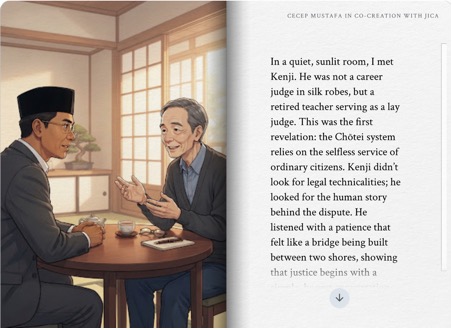
What struck me most about the Chōtei Court is that justice does not always have to begin with a judgment.
Sometimes, it begins with a conversation.
The Chōtei system offers an interesting lesson in how courts can approach disputes with a degree of compassion that is sometimes difficult to find in conventional litigation. At its heart is a simple idea: people who come to court do not always need someone to declare who has won and who has lost. Sometimes they need someone to help them understand the problem, see the weaknesses in their own position, and find a way forward without destroying the relationship that brought them into conflict in the first place.
This is where the role of the lay judge becomes particularly interesting.
The lay judges are not simply people who happen to sit beside professional judges. They bring professional experience and practical knowledge from outside the judiciary. Many of them have expertise in particular fields, yet their contribution is not primarily driven by the expectation of a large financial reward. Their service reflects something increasingly rare in modern institutional life: the willingness to contribute knowledge and experience for the public good.
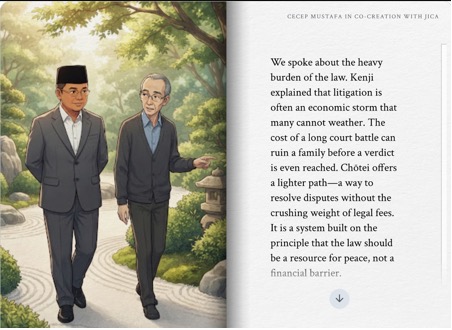
There is an almost paradoxical feature here. A system may achieve a high settlement rate, sometimes resolving more disputes through agreement than through determination on the merits, yet the individuals who contribute to that success do not necessarily receive a corresponding financial reward. In that sense, their contribution comes remarkably close to a form of public service or even quasi-pro bono participation.
Perhaps this tells us something important about justice. Not every contribution to justice can be measured by the number of cases decided, the length of a judgment, or the amount of remuneration attached to it.
For people living in remote, outermost, and disadvantaged areas, the meaning of this service becomes even more concrete. When a Chōtei panel must travel from an urban centre to a rural community, the system provides travel expenses and an honorarium. It is a small institutional gesture, but it carries a larger message: access to justice should not depend entirely on where a person happens to live.
Justice that remains in the city is technically available, but socially distant.
And sometimes the most powerful intervention of a judge is remarkably simple.
A judge may tell a party or his or her lawyer, in effect, “Your evidence is weak.”
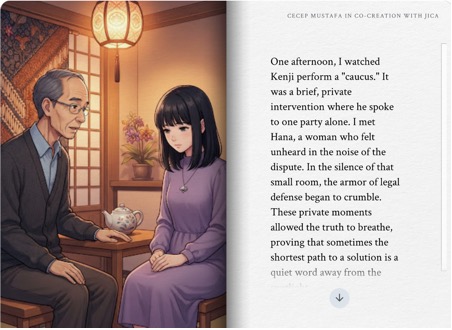
There is no grand legal theory in that sentence. Yet, when communicated appropriately, including through caucus, it can function as a valuable reminder. The message is not necessarily, “You will lose.” Rather, it may be, “Please look carefully at the strength of your case before spending more time, money, and emotional energy pursuing it.”
For many lawyers and litigants, such a reminder can be accepted precisely because it is part of a facilitated process rather than a formal judgment. It allows people to reconsider their position without necessarily losing face.
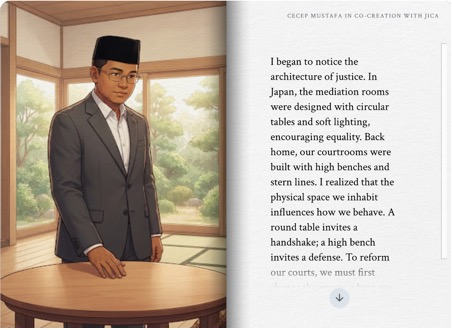
This is one of the quiet strengths of ADR.
The court becomes not merely an institution that determines disputes, but a place where disputes can be de-escalated.
There is also an important socio-legal lesson concerning incentives.
Litigation systems inevitably create economic incentives. If lawyers are remunerated according to the amount of work or time invested, there can be a structural incentive for proceedings to become longer. In some contexts, a case that travels from one stage to another, eventually reaching cassation, may generate more professional fees simply because more professional work is required.

Yet there is another possible culture: when lawyers are not primarily charging by the hour for ordinary litigation, there can be a stronger practical incentive to resolve a case efficiently. The faster one matter is completed, the sooner the lawyer can serve another client.
Of course, this does not mean that speed should replace careful advocacy. Lawyers have legitimate professional duties, and complex cases sometimes require time. But the comparison exposes an important question: what behaviour does a legal system financially reward?
We often ask whether judges, lawyers, and courts are behaving properly. Perhaps we should also ask a prior question: What incentives have we designed around them?
Even judges operate within institutional incentive structures. Where remuneration or case-related funding is connected to actual participation in cases, the economic architecture of the system inevitably affects how judicial work is organised. This does not mean that judges are motivated merely by money. It means something more fundamental: institutions shape behaviour, sometimes quietly and unintentionally.
That is why judicial reform cannot consist only of changing statutes, regulations, or court procedures.

We also need to examine the human beings who operate those institutions, the resources available to them, and the incentives surrounding their daily decisions.
The Chōtei experience therefore offers more than a technical lesson about alternative dispute resolution. It suggests a different philosophy of justice.
Justice can be authoritative without being distant.
It can be professional without becoming mechanical.
It can be efficient without becoming impatient.

And perhaps most importantly, it can be compassionate without becoming weak.
The lay judge who contributes expertise without expecting extraordinary financial reward, the court that pays the cost of bringing justice to remote communities, the judge who quietly tells a lawyer that the evidence is not strong enough, and the lawyer who recognises that an efficiently resolved case allows another client to be served: these may appear to be small details.
But institutions are built from such details.
The deepest lesson, therefore, may be that access to justice is not simply about opening the courthouse door. It is about creating a system in which people can enter that door, be heard with dignity, understand the risks they face, and, where possible, leave without having to destroy one another.
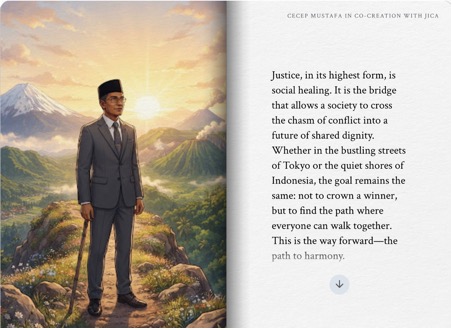
Perhaps that is the quiet wisdom of Chōtei: sometimes the most successful court case is the one that never needs to become a judgment.

Untuk Mendapatkan Berita Terbaru Suara BSDK, Follow Channel WhatsApp: SUARABSDKMARI