



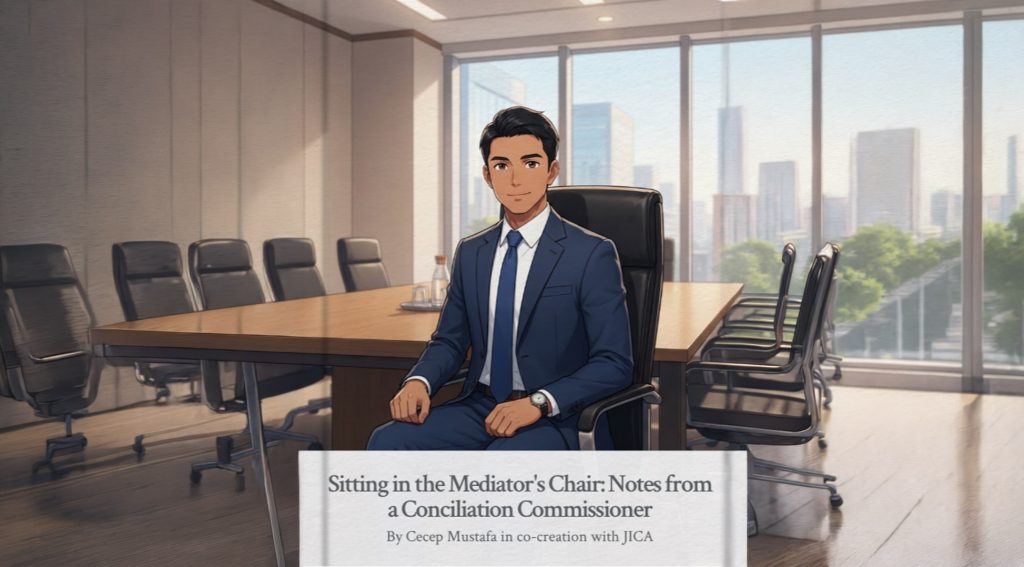
In a room at the Tokyo Summary Court, three people sit down to hear two parties who are locked in a dispute over a rent increase. One is a judge, one is a lawyer, and one is a real estate appraiser. Nobody bangs a gavel. Nobody calls out “court is now in session!” There is only listening, weighing, and asking questions with care.
This is chotei, court-annexed conciliation, or mediation. And I have had the honor of serving on its panels.
Community service, entrusted by the state
Where I come from, in Indonesia, we have a tradition called kerja bakti: neighbors turn out on a weekend to clear rubbish and unblock the drains, unpaid, because the neighborhood belongs to everyone. Serving as a conciliation commissioner feels like a judicial version of that. Ordinary citizens are trusted to help clear the “drain” that has clogged up between two quarreling parties. And the appointment is official. According to the sources I studied, commissioners are appointed by Japan’s Supreme Court twice a year, in April and October.
I see it as an honor rather than a burden, because there is a philosophy behind it: justice is not the exclusive property of people in robes. The state recognizes that a rent dispute is about people’s lives, about homes, kitchens, and a good night’s sleep. Resolving it takes the wisdom of citizens as well as the wording of statutes.
Two cases, one lesson
That day there were two rent-increase cases. On paper, both were simple: the landlord wants to raise the rent, the tenant objects. In the room, though, the numbers never stand alone. There were stories about maintenance costs, about a tenant’s loyalty over a decade or more, and about whether anyone felt valued.
This is where the makeup of the panel matters. The lawyer reads the legal position, the appraiser reads market prices and the condition of the building, and the judge keeps the procedure on track. Three ways of seeing add up to one complete picture. One head is rarely enough for a case with this many sides.
The matter was not resolved that day. The panel adjourned for a month. Anyone raised on “if it can be done today, why wait until tomorrow” might feel impatient. But the pause is really a mechanism. Both sides get time to reflect, recalculate, and cool down. Compromise rarely comes from a boiling mind. It comes from a mind that has had a cup of tea and slept on it, whether for one night or thirty.
A friendly bureaucracy, and a room without the commute
Applications for conciliation are filed on numbered forms. Template 201 covers the application itself, and then a whole series of other forms runs up to 231. I couldn’t help smiling, because it felt like a restaurant menu with 31 items: number such-and-such for a rent dispute, number so-and-so for something else. But behind the joke there is real wisdom. Ordinary people shouldn’t have to draft a petition from scratch. A good form is a tidy front door, and a good justice system makes sure its citizens don’t get lost on their own doorstep.
The mediation rooms also support teleconferencing through Webex. A party who lives far away doesn’t have to take a whole day off just to sit through an hour-long session. Of course, there is the hazard of our age: “Sorry, you’re still on mute!” But if the occasional muted microphone is the price of wider access to justice, I’ll gladly pay it.
Who sits in those chairs?
One set of numbers made me stop and think. As of April 2026, the Tokyo Summary Court has 404 commissioners, 101 of them women, about 25%. Their backgrounds are varied: roughly 45% are lawyers, 12% real estate appraisers, 6% certified public accountants or tax accountants, 3% architects, 3% medical doctors, 2% labor consultants, 2.5% surveyors or judicial scriveners, and 27% retirees or others.
Two things are worth noting. First, professional diversity is a strength, because real disputes don’t arrive labeled “pure legal matter.” A rent dispute needs an appraiser, a construction dispute needs an architect, and a workplace dispute needs a labor specialist. Second, 25% women means there is still homework to do on balance. Admitting that a system isn’t perfect is an honest first step toward improving it.
Mediators aren’t made by books alone
Commissioner training here rests on two cycles of experience. The first is OJT, on-the-job training: taking part in panel discussions before and after sessions, watching how issues are mapped out live in the room, and being mentored by senior commissioners. The second is OFF-JT, learning away from the sessions: case study discussions, role-play simulations, and case management forums.
New members also receive an orientation: lectures from judges on procedure and ethics, talks from senior commissioners on the right stance to take, a chance to observe real sessions, and an introduction to the facilities and to managing time. To me, mediation is a skill that has to be trained like swimming. Nobody becomes a swimmer by reading about water.
The process itself has a three-act rhythm. The first session gathers information, the second builds a framework for a solution, and the third persuades the parties toward an agreement. With that rhythm, mediation doesn’t drift into an endless chat.
Looking back at our own home
At this point my thoughts travel home to Indonesia, which is currently discussing reforms to its civil procedure law and to the Supreme Court’s regulations on mediation. I should be frank about the limits of what I know. The sources I studied contain Tokyo’s data and training curricula, but no empirical statistics on how cases are resolved in our own District Courts. So I can’t claim our system “fails” or “succeeds” on the basis of numbers. What I can offer is food for thought, not a verdict.
- Open chairs to non-legal professionals. The court’s mediator roster should include certified real estate appraisers, public accountants, architects, and labor experts alongside lawyers. A technical case needs technical eyes.
- Give mediation a rhythm and a deadline. A three-session model (mapping the information, finding common ground, persuading toward agreement) keeps mediation from dragging on. Endless mediation is just a postponed trial with a friendlier name.
- Train mediators the way we train other professionals. Observing live sessions, holding discussions before and after, running interview simulations, and senior-junior mentoring should be conditions of certification, not optional extras.
- Welcome new mediators with a proper orientation covering ethics, the code of conduct, getting around the court facilities, and managing time.
Closing: justice doesn’t have to be win or lose
What I carry home most from the conciliation room is this: justice doesn’t always have to take the form of a fight. There is a kind of justice that appears when two parties who started out suspicious of each other finally nod together, not because they were forced to, but because they felt heard. A mature legal system knows when to be firm and when to provide a seat for people to sit down together.
And to anyone who has ever doubted whether an ordinary citizen has a place in matters of justice, I want to say: you do. This community service is open to all, and the drain belongs to all of us.
Untuk Mendapatkan Berita Terbaru Suara BSDK, Follow Channel WhatsApp: SUARABSDKMARI