



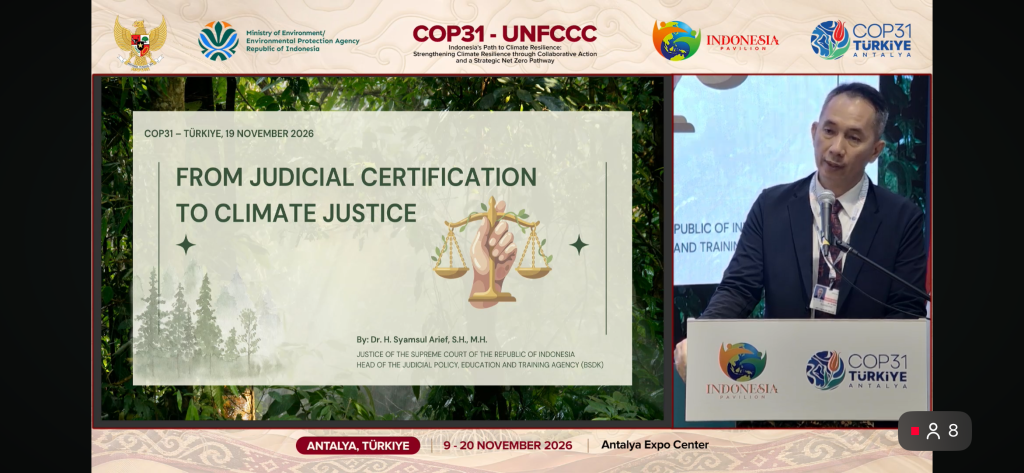
COP31 – Türkiye, 19 November 2026 – The climate crisis is not only an environmental issue. It is also a test of law, justice, and judicial courage.
Indonesia, like many developing countries, faces significant economic pressures. The country needs investment, energy, employment, and economic growth while also navigating global economic and geopolitical challenges.
At times, these pressures may put environmental protection at risk. Every country needs development, but development must not come at the expense of the environment or the future of the next generations.
This is where judges play an important role.
Judges are not against development. However, they must ensure that development respects the law and protects the environment.
Judicial Certification and Environmental Decisions
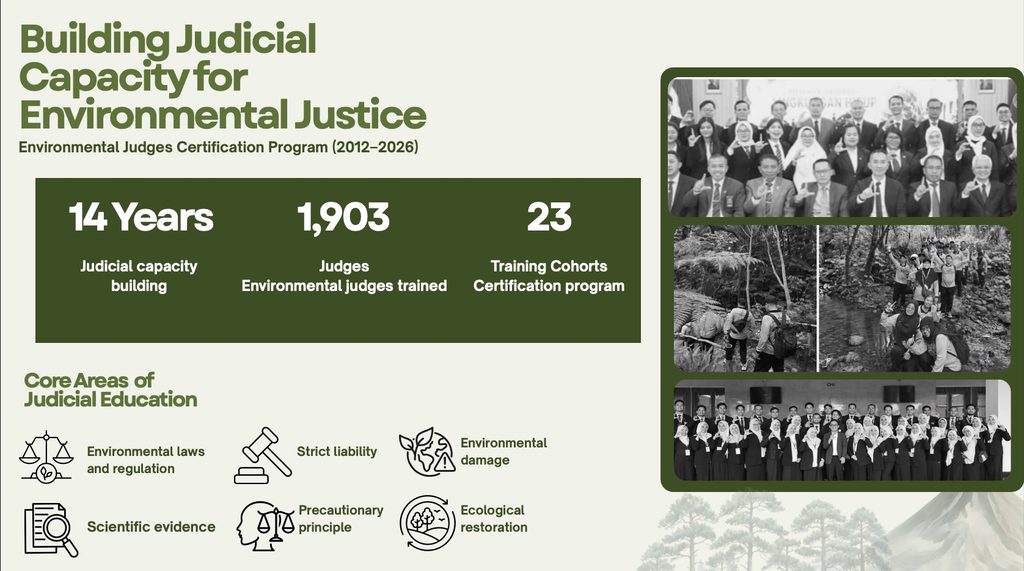
Since 2012, the Supreme Court of Indonesia has implemented the Environmental Judges Certification Program.
By 2026, the program had trained 1,903 judges through 23 training batches.
The program goes beyond environmental laws and regulations. Judges also learn about scientific evidence, the precautionary principle, strict liability, environmental damage, and ecological restoration.
Judges do not need to become scientists. Nevertheless, they must understand scientific evidence to make sound and well-informed environmental decisions.
Over the past fourteen years, Indonesian courts have issued several important environmental decisions.
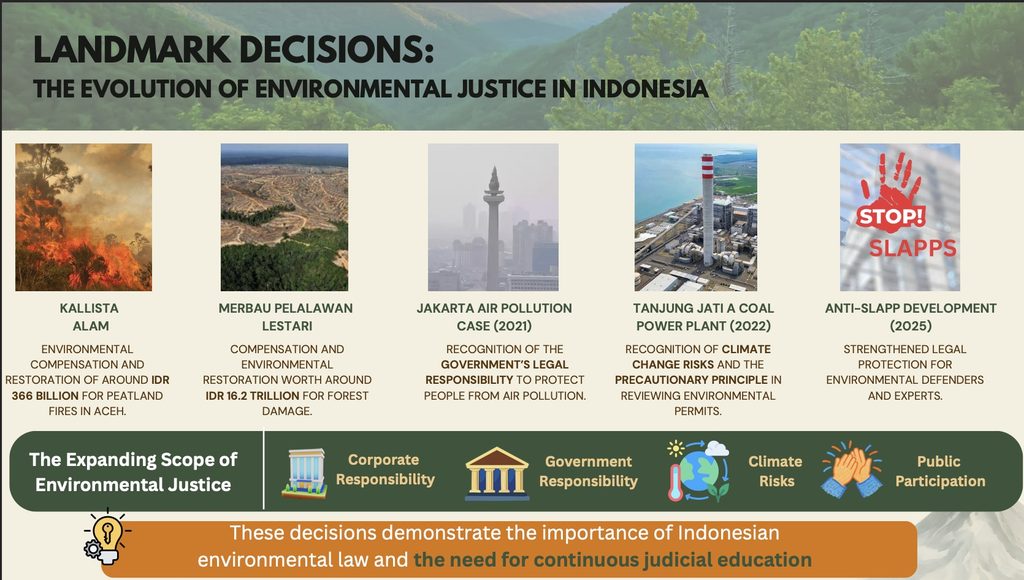
In the Kallista Alam case, the court ordered a company to pay approximately IDR 366 billion for environmental damage and restoration following peatland fires in Aceh.
In the Merbau Pelalawan Lestari case, the Supreme Court ordered compensation and environmental restoration amounting to approximately IDR 16.2 trillion for forest damage.
These cases demonstrate that environmental destruction carries serious legal and financial consequences.
In 2021, the Jakarta air pollution case recognized that the government also has a legal responsibility to protect the public from air pollution.
In 2022, in the Tanjung Jati A coal-fired power plant case, the court considered climate change and the precautionary principle when reviewing an environmental permit.
More recently, in 2025, Indonesian courts and the Constitutional Court strengthened legal protection for environmental defenders and experts through the Anti-SLAPP principle.
These decisions reflect an important development in Indonesian environmental law. Courts are addressing not only corporate responsibility but also government accountability, climate risks, and public participation.
Although these decisions cannot all be regarded as direct results of the certification program, they demonstrate the importance of continuous judicial education.
Judges must continue learning as environmental law and scientific knowledge evolve.
Judicial Independence and Climate Justice
Economic growth, investment, and national development are important. Environmental protection, however, is equally essential.
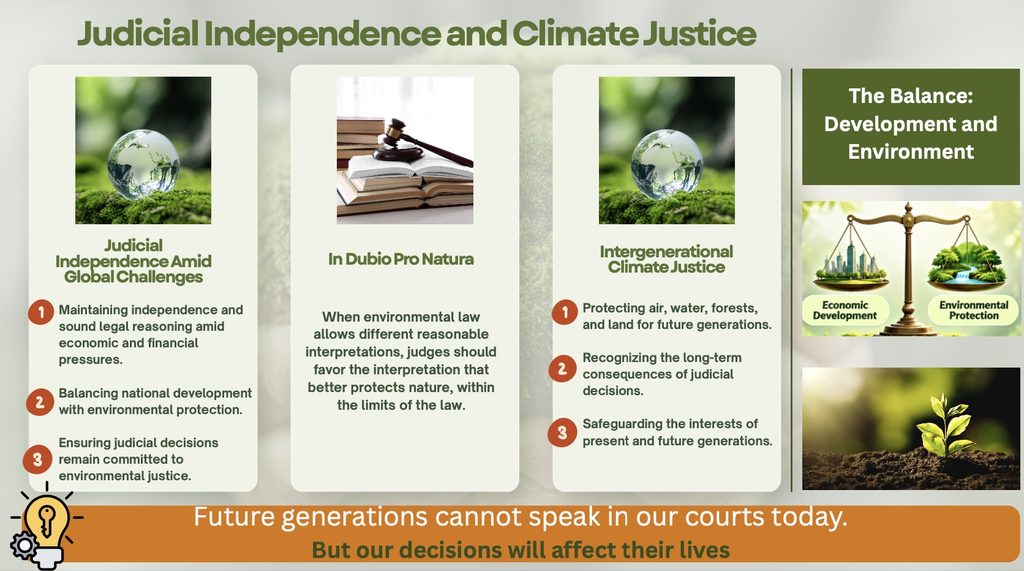
Governments may face difficult choices due to financial pressures and global economic interests. In such situations, judges must remain independent, reasonable, and committed to environmental justice.
One important principle is in dubio pro natura. This principle emphasizes that when environmental law permits several reasonable interpretations, judges should favor the interpretation that provides greater protection for nature, within the limits of the law.
Climate justice does not mean stopping development. It means ensuring that today’s development does not destroy the future.
Judicial decisions made today will affect the air, water, forests, and land of tomorrow. They will affect children, newborn babies, and even generations that have not yet been born.
Future generations cannot speak before the courts today, but judicial decisions will shape their lives.
Justice must therefore protect not only those living today but also those who will live tomorrow.
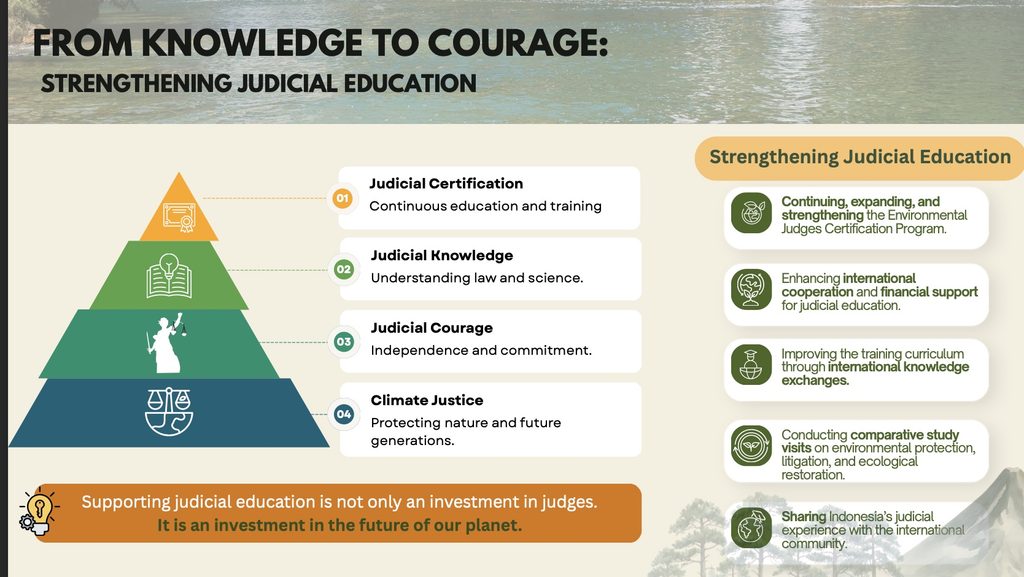
Conclusion: From Knowledge to Courage
The Environmental Judges Certification Program is not only about teaching judges environmental law. It is also about transforming knowledge into courage—the courage to uphold the law, protect nature, and advance climate justice.
For this reason, the program must continue, expand, and become stronger.
Stronger international cooperation, including broader financial support for judicial education and training, will be essential. The training curriculum can also be enhanced through international exchanges and comparative study visits.
Indonesian judges should have more opportunities to learn directly from countries with successful experiences in environmental protection, environmental litigation, and ecological restoration. At the same time, Indonesia stands ready to share its experience with other countries.
Supporting judicial education is not merely an investment in judges. It is an investment in the future of the planet.
“The Earth needs good judges.”
Judges who understand the law.
Judges who respect science.
Judges who remain independent.
Judges who have the courage to protect nature and defend climate justice.
The legacy of a good judge is measured not only by the decisions they make, but also by the lives they protect, the ecosystems they help restore, and the future they help preserve.
Climate justice is not only for the present generation. It is also for those who have not yet been born.

Untuk Mendapatkan Berita Terbaru Suara BSDK, Follow Channel WhatsApp: SUARABSDKMARI