


Close Menu
Suara BSDKSuara BSDK
  • Beranda
  • Artikel
  • Berita
  • Features
  • Sosok
  • Filsafat
  • Roman
  • Satire
  • Video
  • Liputan Khusus

Subscribe to Updates

Get the latest creative news from FooBar about art, design and business.

What's Hot

Mempererat Silaturahmi dan Menjaga Kebugaran: Kemeriahan Senam Pagi Bersama di Gedung Sekretariat Mahkamah Agung RI

November 6, 2026

Dilmil IV-16 Balikpapan Jalin Sinergi dengan SMKN 1 Balikpapan, Buka Peluang PKL dan Edukasi Hukum Bagi Generasi Muda

November 6, 2026

Hakim Anak Dibekali Pemahaman Hak Anak, Pekerja Sosial Kemensos: “Orang Tua Jangan Hanya Sibuk Cari Uang”

November 6, 2026
Instagram YouTube
Suara BSDKSuara BSDK
  • Beranda
  • Artikel
  • Berita
  • Features
  • Sosok
  • Filsafat
  • Roman
  • Satire
  • Video
  • Liputan Khusus
Suara BSDKSuara BSDK
  • Beranda
  • Artikel
  • Berita
  • Features
  • Sosok
  • Filsafat
  • Roman
  • Satire
  • Video
  • Liputan Khusus
Home » Enforcing Truth and Justice: Modern Pressures and Paradoxes

Enforcing Truth and Justice: Modern Pressures and Paradoxes

Bismo Jiwo AgungBy Bismo Jiwo AgungMay 5, 2026 · 15:56 WIB10 Mins ReadNo Comments
Share
Facebook Twitter Threads Telegram WhatsApp

I. Background

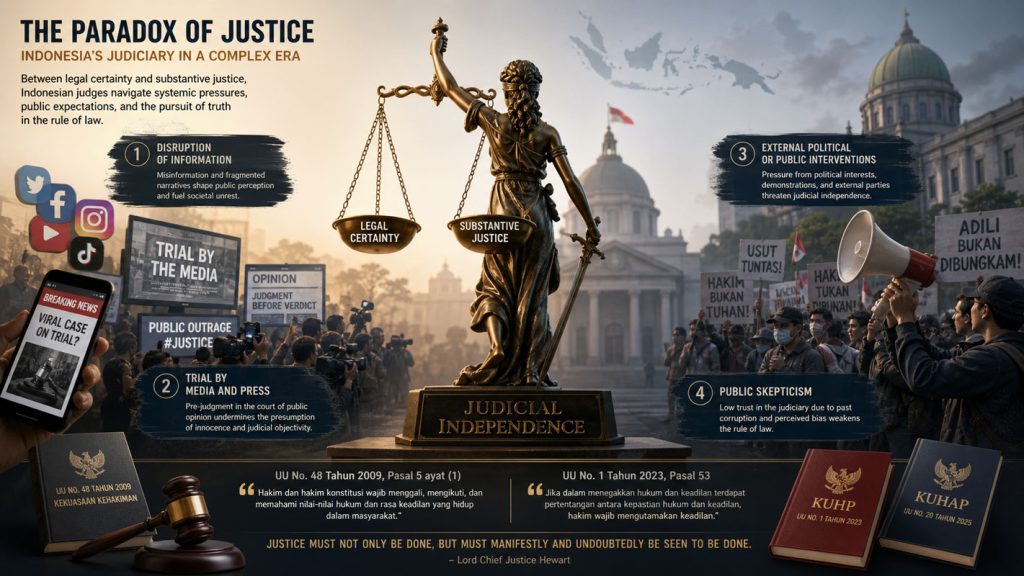
    Echoing Lord Chief Justice Hewart’s famous principle that ‘justice must not only be done, but must manifestly and undoubtedly be seen to be done (Jacob, 2009), Indonesian Chief Justice Prof. Dr. Sunarto, S.H., M.H., reiterated this standard at the Chamber’s Plenary Session in Jakarta on November 9, 2025 (Hasany, 2025). Manifesting justice in the real world necessitates a deep connection with the lived experiences and values of a society. Therefore, achieving justice requires a theoretical approach to justice using different methods, each of which produces unique results.

    From a strictly textualist perspective, the application of law is often viewed as a straightforward exercise in literal implementation. This viewpoint suggests that when a statute is drafted by experts and ratified by parliament—free from external influence—the resulting norms leave no room for interpretive debate and should inherently produce equitable outcomes for the public. Thus, in theory of law widely known as a positivism (Asshiddiqie & Safa’at, 2012; Kelsen, 1992, 2005) or legalism paradigm. Conversely, critics of legal positivism and strict legalism argue that such frameworks are excessively rigid. They contend that rather than reflecting communal justice, these concepts often serve primarily to advance the interests of the sovereign (Rahardjo, 2007). Furthermore, when judicial outcomes are entirely predictable and bound strictly to the letter of the law, it becomes nearly impossible to differentiate between human reasoning and machine logic (Atmasasmita, 2012). The discourse regarding the most appropriate paradigm for enforcing justice remains a perpetual subject of debate within legal philosophy.

    Modern legal complexities require more than a rigid application of theory. Judges must be prepared to look deeper into the societal context of each case, preserving their integrity and the rule of law against the threats of institutional interference, conflicts of interest, and corruption (Mirza & Parahyanti, 2025). Despite the mandate for theoretical mastery, judges are tasked with the near-impossible duty of being both saintly and impartial while satisfying the demands of all parties. This divine weight rests heavily upon the shoulders of mortal beings who remain, by nature, imperfect.

    This work examines the inherent challenges and paradoxes facing the Indonesian judiciary as they implement Articles 3 and 5 of Act No. 48 of 2009 on Judicial Power, alongside the newly enacted Criminal Code (Act No. 1 of 2023) and the Criminal Procedure Code (Act No. 20 of 2025). Within this modern context, the study utilizes a qualitative methodology, drawing upon field observations, extensive literature reviews, and a series of interviews conducted with a diverse cohort of Indonesian judges across varying levels of seniority.

    II. Key Findings

    A. Systemic Constraints on the Realization of Justice within the Indonesian Judiciary

      The confluence of digital advancement, fluctuating economic conditions, and evolving social values has fundamentally restructured the challenges within the judiciary. Current observations suggest that the courts must navigate a spectrum of multidimensional pressures, such as:

      1. The disruption of information;
        Pervasive digital disruption has catalyzed a profound shift in human behavioural archetypes, altering how individuals interact with information, institutions, and one another (Dienaputra, 2020). This shift is driven by the omnipresence of the digital landscape, where the proliferation of pervasive and often orchestrated misinformation exerts a global influence on human behaviours (Walker, 2011). In Indonesia, misinformation regarding judicial proceedings is particularly prevalent in cases involving national figures or viral content. This phenomenon is closely linked to shifting media paradigms, where the dissemination of fragmented narratives can distort public perception and incite societal unrest. Furthermore, when a verdict fails to align with popular expectations, the judiciary often becomes the target of public animosity—a reaction frequently fueled by a lack of engagement with the ratio decidendi or the evidentiary facts presented at trial.
      2. Trial by The Media and Press;
        Following the disruption of information bring out the phenomena of trial by media and press. The concept of ‘trial by the press and media’ refers to an extrajudicial process in which press and media outlets assume the role of the court. Through the construction of preemptive narratives, the media and the public interfere with the sanctity of the judicial process, undermining the court’s mandate to conduct an objective assessment of the evidence (Suresh & George, 2021). The phenomena of ‘trial by media’ and ‘trial by the press’ function as a double-edged sword within the legal ecosystem. While they serve a vital democratic role by fostering public awareness and encouraging judicial accountability, they simultaneously pose a significant risk as instruments of indirect intervention and institutional intimidation against the judiciary (Agung, 2026).
      3. External political or public interventions;
        Within legal and political frameworks, intervention is defined as external interference intended to manipulate the resolution of a dispute. In the judicial sphere, such actions disrupt the bilateral relationship between the litigants and the court, inherently threatening the neutrality of the proceedings. Beyond direct institutional pressure, the judiciary now faces a rising trend of public activism-demonstration. Demonstrations have transitioned from challenging executive policies to actively seeking to dictate judicial decisions, posing a novel threat to judicial autonomy. Demonstrations are more than manifestations of dissatisfaction; they are essential exercises of sovereignty that ensure government accountability. However, their democratic legitimacy is fragile. If these movements are manipulated by external interests to undermine law enforcement, they devolve from a means of conveying truth into a destructive and manipulative tool that threatens the very foundations of the rule of law.
      4. Public scepticism;
        Public confidence in the Indonesian judiciary has reached a critical nadir, a direct consequence of historical corruption and perceived systemic bias. This pervasive scepticism serves as the primary catalyst for ‘trial by media’ and populist demonstrations. Even when a verdict is theoretically sound and strictly adheres to existing regulations, it is frequently met with allegations of judicial bribery. The lack of public confidence in the courts makes the rule of law more vulnerable and increases the risk that public actors, legislatures, and ordinary people might ignore court orders and mandates over time (Thamrin, 2020).
      Baca Juga  Pengaturan Hukum Adat dan Sanksi Pidananya dalam KUHP Baru

      B. The Paradox

      Law Number 48 of 2009 presents two critical, yet potentially conflicting, obligations for the judiciary. Article 5(1) urges judges to be receptive to the ‘sense of justice’ residing in society, advocating for a sociologically informed approach to adjudication. While the regulation encourages a sociologically informed judiciary, the reality of digital disruption and public scepticism makes identifying a genuine ‘sense of justice’ increasingly difficult. Manipulated information often serves as a veil for certain interests, placing the burden on the judge to uncover the truth. Fulfilling this duty requires immense bravery, as judges often face severe vilification and professional isolation when their decisions diverge from the ‘viral’ narrative. The path of judicial independence, therefore, remains a solitary and challenging journey.

      In such instances, abstract legal theories often fail to satisfy the public’s visceral demand for justice. The conceptualization of ‘justice’ remains inherently pluralistic; every stakeholder maintains a personalized definition based on their unique socio-economic or moral perspective. Consequently, it is a logistical and judicial impossibility for a court to render a decision that satiates the competing appetites of a fractured public, as one party’s ‘justice’ is inevitably perceived as another’s ‘injustice’.

      However, the article 53 of Law Number 1 of 2023 concerning Criminal Code (KUHP) states that “When adjudicating a criminal case, a judge is obliged to uphold the law and justice. If, in upholding the law and justice, there is a conflict between legal certainty and justice, the judge is obliged to prioritize justice.” This legal norm mirrors the triadic tension identified by Gustav Radbruch, who posited that the values of legal certainty (Rechtssicherheit), expediency or utility (Zweckmäßigkeit), and justice (Gerechtigkeit) often enter into a state of conflict. Radbruch’s philosophy suggests that while certainty is vital for the stability of the state, there exists a threshold where positive law becomes so ‘intolerably unjust’ that it must yield. In such critical junctures, the judicial mandate shifts toward enforcing the values that are most substantively just and socially beneficial (Prasetyo & Barkatullah, 2017; Rasjidi & Sidharta, 1989; Santoso, 2015).

      Baca Juga  Ketika Hukum Lupa pada Manusia: Membaca Thomas Paine Hari Ini

      In the face of conflicting legal values, the judiciary must determine whose justice is being served. Is the priority the justice of the victim, the fundamental rights of the perpetrator, or the moral and legal integrity of the judge’s own decision?

      These inquiries form a decades-long paradox within judicial discourse, yielding diverse interpretive responses. One school of thought posits that in criminal proceedings, the judge must prioritize the restorative justice of the victim. Conversely, proponents of legal formalism argue that the Criminal Code and the Criminal Procedure Code were established to ensure procedural equality; thus, prioritizing one party over the other constitutes a fundamental injustice. A third perspective suggests that regardless of competing interests, the judge’s sole duty is to uphold factual integrity, adhering strictly to the evidentiary record and the dictates of their professional conviction.

      Under the weight of unprecedented public pressure, judges are often urged to perform as infallible instruments of divine justice. This creates an unsustainable paradox: the people demand a manifestation of perfection from individuals who possess inherently mortal souls and imperfect bodies. Acknowledging this ‘human element’ is essential to understanding the immense burden carried by the modern judiciary in its struggle to enforce justice for all.

      C. Closing Statement

        The preceding discussion underscores that upholding truth and justice requires active civic stewardship. The disruption of information, trial by the media and press, external political or private interventions and public scepticism is involved the role of all citizen. It is incumbent upon society to distinguish between manufactured narratives and objective truth. The ideal of universal justice can only be manifested if the populace affords the judiciary the necessary autonomy to function without interruption. By resisting the urge to intervene in ongoing cases, society protects the very independence required for the rule of law to flourish.

        REFERENCES

        Agung, B. jiwo. (2026, April 8). Dinamika Trial By The Press and Media & Contempt Of Court. Dandapala.

        Asshiddiqie, J., & Safa’at, M. A. (2012). Teori Hans Kelsen Tentang Hukum. Konstitusi Press.

        Atmasasmita, R. (2012). Teori Hukum Integratif : Rekonstriksi terhadap Teori Hukum Pembangunan dan Teor Hukum Progressif. Genta Publishing.

        Dienaputra, R. D. (2020). Historical Disruption Through Technology. International Journal of Innovation, Creativity and Change. Www.Ijicc.Net, 12(4), 2020. www.ijicc.net

        Hasany, A. Z. Al. (2025, November 9). Keadilan Bukan Hanya Harus Ditegakkan, Namun Harus Terlihat Ditegakkan. MARINews.

        Jacob, R. (2009). Knowledge of the World and the Act of Judging. Osgoode Hall Review of Law and Policy, 2(1), 22–28. http://digitalcommons.osgoode.yorku.ca/ohrlphttp://digitalcommons.osgoode.yorku.ca/ohrlp/vol2/iss1/2

        Kelsen, H. (1992). Introduction To the Problems Of Legal Theory (B. L. Paulson & S. L. Paulson, Eds.). Clanderon Press.

        Kelsen, H. (2005). Pure Theory of Law. The Lawbook Exchange LTD.

        Mirza, M., & Parahyanti, E. (2025). Meaningful Work Protects Judges with Occupational Stress, Secondary Traumatic Stress, and Burnout. Jurnal Hukum Dan Peradilan, 14(1), 91–130. https://doi.org/10.25216/jhp.14.1.2025.91-130

        Prasetyo, T., & Barkatullah, A. H. (2017). Filsafat, Teori & Ilmu Hukum: Pemikiran Menuju Masyarakat yang Berkeadilan dan Bermartabat. Raja Grafindo Persada.

        Rahardjo, S. (2007). Membedah Hukum Progresif. Kompas.

        Rasjidi, L., & Sidharta, B. A. (1989). Filsafat Hukum Mazhab dan Refleksinya. Remaja Karya.

        Santoso, A. (2015). Hukum, Moral, dan Keadilan : Sebuah Kajian Filsafat Hukum. Kencana.

        Suresh, N., & George, L. S. (2021). Trial by media: An overview. Int’l JL Mgmt. & Human, 4(2), 267.

        Thamrin, H. (2020). LAW ENFORCEMENT IN INDONESIA IN THE PERSPECTIVE OF LAW STATES. Awang Long Law Review, 2(2), 89–92.

        Walker, R. (2011). The Civil War: A Visual History (J. Dunne, P. Regan, G. Farfour, & S. Mumford, Eds.). DK Publishing.
        Bismo Jiwo Agung
        Kontributor
        Bismo Jiwo Agung
        Hakim Pengadilan Negeri Bintuhan

        Untuk Mendapatkan Berita Terbaru Suara BSDK, Follow Channel WhatsApp: SUARABSDKMARI

        Filsafat Hukum Hukum Indonesia judicial independence Legal Philosophy
        Share. Facebook Twitter Threads Telegram WhatsApp Copy Link

        Related Posts

        Merawat Etika Hakim di Ruang Sidang Anak

        November 5, 2026

        Penggunaan Artificial Intelligence dalam Peradilan: Pelajaran dari Pedoman Internasional bagi Mahkamah Agung Indonesia

        November 5, 2026

        Cepat dan Cermat: Cara Mahkamah Agung Menyelesaikan Perkara

        November 4, 2026
        Leave A Reply Cancel Reply


        Demo
        Top Posts

        Notoir Feiten dan Relevansinya Dalam Personalisasi Pengetahuan Era Kini

        November 6, 2026

        Dari FGD hingga Semangkuk Mi Kuah, BSDK Tunjukkan Wajah Pendidikan Peradilan yang Humanis

        October 28, 2026

        Adu Domba: Bukan Sekedar Adu Kekuatan

        October 23, 2026

        Asap di Bumi Serambi Makkah: Jauh dari Titik Api, Dekat dengan Ujian Keadilan

        October 20, 2026
        Don't Miss

        Mempererat Silaturahmi dan Menjaga Kebugaran: Kemeriahan Senam Pagi Bersama di Gedung Sekretariat Mahkamah Agung RI

        By JohanesNovember 6, 20260

        Jakarta, 6 November 2026 – Sejumlah pejabat dan pegawai di lingkungan Gedung Sekretariat Mahkamah Agung…

        Dilmil IV-16 Balikpapan Jalin Sinergi dengan SMKN 1 Balikpapan, Buka Peluang PKL dan Edukasi Hukum Bagi Generasi Muda

        November 6, 2026

        Hakim Anak Dibekali Pemahaman Hak Anak, Pekerja Sosial Kemensos: “Orang Tua Jangan Hanya Sibuk Cari Uang”

        November 6, 2026

        Notoir Feiten dan Relevansinya Dalam Personalisasi Pengetahuan Era Kini

        November 6, 2026
        Stay In Touch
        • YouTube
        • TikTok
        • WhatsApp
        • Twitter
        • Instagram
        Top Trending
        Demo

        Recent Posts

        • Mempererat Silaturahmi dan Menjaga Kebugaran: Kemeriahan Senam Pagi Bersama di Gedung Sekretariat Mahkamah Agung RI
        • Dilmil IV-16 Balikpapan Jalin Sinergi dengan SMKN 1 Balikpapan, Buka Peluang PKL dan Edukasi Hukum Bagi Generasi Muda
        • Hakim Anak Dibekali Pemahaman Hak Anak, Pekerja Sosial Kemensos: “Orang Tua Jangan Hanya Sibuk Cari Uang”
        • Notoir Feiten dan Relevansinya Dalam Personalisasi Pengetahuan Era Kini
        • Ini Empat Lembaga Penting bagi Anak Berhadapan dengan Hukum

        Recent Comments

        1. Aman on Kejahatan Siber: Hakim Harus Cermat Menguji Bukti
        2. Dr. Sakwanah on Ketua MS Aceh Apresiasi Pelatihan BSDK, Harapkan Diklat Khusus Hukum Acara Jinayat
        3. Herman on Di Balik Mangrove, Ada Keadilan yang Harus Diperjuangkan
        4. Abdul Mustopa on MOVE!
        5. Rizka on Problematika Pelaksanaan Eksekusi Pembayaran Sejumlah Uang Terhadap Objek Jaminan Berupa Benda Bergerak
        Hubungi Kami

        Badan Strategi Kebijakan dan Pendidikan dan Pelatihan Hukum dan Peradilan Hukum dan Peradilan
        Mahkamah Agung RI

        Kantor: Jl. Cikopo Selatan Desa Sukamaju, Kec. Megamendung
        Bogor, Jawa Barat 16770

        Kirimkan reportase berita, opini, features dan artikel lainnya ke email suarabsdk.com : 
        redpelsuarabsdk@gmail.com

        Telepon: (0251) 8249520, 8249522, 8249531, 8249539

        Kategori
        Beranda Artikel Berita Features Sosok KRITERIA TULISAN
        Filsafat Roman Satire Video BALACADAS
        Connect With Us
        • Instagram
        • YouTube
        • WhatsApp
        Aplikasi Internal
        Logo 1 Logo 2 Logo 3 Logo 3 Logo 5
        Logo 4 Logo 4 Logo 4 Logo 5 Logo 5 Logo 5
        Kontributor
        • Avatar photo Ahmad Junaedi
        • Avatar photo Mohammad Khairul Muqorobin
        • Avatar photo Aman
        • Avatar photo Irvan Mawardi
        • Avatar photo Cecep Mustafa
        • Avatar photo Yudhistira Ary Prabowo
        • Avatar photo Khoiruddin Hasibuan
        • Avatar photo Ari Gunawan
        • Avatar photo Muamar Azmar Mahmud Farig
        • Avatar photo Syailendra Anantya Prawira
        • Avatar photo Ghesa Agnanto Hutomo
        • Avatar photo Johanes
        • Avatar photo Muhammad Rizqi Hengki
        • Avatar photo Agus Digdo Nugroho
        • Avatar photo Syamsul Arief
        • Avatar photo Jatmiko Wirawan
        • Avatar photo Timbul Bonardo Siahaan
        • Avatar photo Muhammad Adiguna Bimasakti
        • Avatar photo Syihabuddin
        • Avatar photo Dahlan Suherlan
        • Avatar photo Muhammad Zuchri Nasuha Lubis
        • Avatar photo Taufikurrahman
        • Avatar photo Cik Basir
        • Avatar photo Zulfahmi
        • Avatar photo Maria Fransiska Walintukan
        • Avatar photo M. Natsir Asnawi
        • Avatar photo Unggul Senoaji
        • Avatar photo Anton Ahmad Sogiri
        • Avatar photo Bagus Partha Wijaya
        • Avatar photo Abdi Munawar Daeng Mangagang
        • Avatar photo Adji Prakoso
        • Avatar photo Bintoro Wisnu Prasojo
        • Avatar photo Yoshito Siburian
        • Avatar photo Galang Adhe Sukma
        • Avatar photo Iqbal Lazuardi
        • Avatar photo Sriti Hesti Astiti
        • Avatar photo Ahmad Syahrus Sikti
        • Avatar photo Abdul Azis Ali Ramdlani
        • Avatar photo Harun Maulana
        • Avatar photo Layla Windy Puspita Sari
        • Avatar photo Muhammad Hanif Ramadhan
        • Avatar photo Anisa Yustikaningtiyas
        • Avatar photo Binsar Parlindungan Tampubolon
        • Avatar photo Ferdian Permadi
        • Avatar photo Ganjar Prima Anggara
        • Avatar photo I Gusti Lanang Ngurah Sidemen Putra
        • Avatar photo Eliyas Eko Setyo
        • Avatar photo Firzi Ramadhan
        • Avatar photo Itsnaatul Lathifah
        • Avatar photo Jarkasih
        • Avatar photo Sudiyo
        • Avatar photo Afifah Dwiandini
        • Avatar photo Buang Yusuf
        • Avatar photo Febby Fajrurrahman
        • Avatar photo Garin Purna Sanjaya
        • Avatar photo Marulam J Sembiring
        • Avatar photo Tri Indroyono
        • Avatar photo Letkol Chk Agustono, S.H., M.H.
        • Avatar photo Ardiansyah Iksaniyah Putra
        • Avatar photo Henri Setiawan
        • Avatar photo Irene Cristna Silalahi
        • Avatar photo Marsudin Nainggolan
        • Avatar photo Maulana Aulia
        • Avatar photo Riki Perdana Raya Waruwu
        • Avatar photo Siti Nadhiroh
        • Avatar photo Dr. Syofyan Iskandar, S.H., M.H.
        • Avatar photo Muhamad Zaky Albana
        • Avatar photo Fauzan Prasetya
        • Avatar photo Irwan Rosady
        • Avatar photo Khoiriyah Roihan
        • Avatar photo Redaktur SuaraBSDK
        • Avatar photo Yasin Prasetia
        • Avatar photo Audrey Kartika Putri
        • Avatar photo Cok Istri Bhagawanthi Pemayun
        • Avatar photo Eddy Daulatta Sembiring
        • Avatar photo Fitriyel Hanif
        • Avatar photo Gerry Michael Purba
        • Avatar photo K.G. Raegen
        • Avatar photo Rafi Muhammad Ave
        • Avatar photo Rangga Lukita Desnata
        • Avatar photo Rikatama Budiyantie
        • Avatar photo Silveria Supanti
        • Avatar photo Sugiarto
        • Avatar photo Teguh Setiyawan
        • Avatar photo Achmad Fikri Oslami
        • Avatar photo Agenda Citra Muhammad
        • Avatar photo Ahmad Fuad Noor Ghufron
        • Avatar photo Achmad Nurul Huda
        • Avatar photo Andro Riski Pradipta
        • Avatar photo Anggi Permana
        • Avatar photo Ang Rijal Amin
        • Avatar photo Armansyah
        • Avatar photo Azalia Purbayanti Sabana
        • Avatar photo David Pasaribu
        • Avatar photo Dedi Putra
        • Avatar photo Dewi Maharati
        • Avatar photo Edi Hudiata
        • Avatar photo Gerry Geovant Supranata Kaban
        • Avatar photo Herjuna Praba Wiesesa
        • Avatar photo Hermanto
        • Avatar photo Indarka PP
        • Avatar photo Muhamad Fadillah
        • Avatar photo Nugraha Medica Prakasa
        • Avatar photo Ria Marsella
        • Avatar photo Rizal Arif Fitria
        • Avatar photo Sadana
        • Avatar photo Sahram
        • Avatar photo Saut Erwin Hartono A. Munthe
        • Avatar photo Yusuf Sodhiqin
        • Avatar photo Achmad Pratomo
        • Avatar photo Dr. H. Achmad Setyo Pudjoharsoyo., SH., M.Hum
        • Avatar photo Ahmad Muzayyin Destuladoe
        • Avatar photo Ahmad Faiz Shobir Alfikri
        • Avatar photo Ahmad Farhan Subhi
        • Avatar photo Arie Fitriansyah
        • Avatar photo Arie Guntoro
        • Avatar photo Bismo Jiwo Agung
        • Avatar photo Dharma Setiawan Negara
        • Avatar photo Epri Wahyudi
        • Avatar photo Fajar Widodo
        • Avatar photo Fariz Prasetyo Aji
        • Avatar photo Fauzan Arrasyid
        • Avatar photo Fauzia Rohmah
        • Avatar photo Febry Indra Gunawan Sitorus
        • Avatar photo Hartanto Ariesyandi
        • Avatar photo Mardi Candra
        • Avatar photo Muhammad Irfan Syahputra
        • Avatar photo Muhammad Amin Putra
        • Avatar photo Niko Wijaya
        • Avatar photo Putra Nova A.S
        • Avatar photo Raden Heru Wibowo Sukaten
        • Avatar photo Rahmad Ramadhan Hasibuan
        • Avatar photo Satria Perdana
        • Avatar photo Trisoko Sugeng Sulistyo
        • Avatar photo Umar Dani
        • Avatar photo Wahyu Budi Santoso
        • Avatar photo Wilmar Ibni Rusydan
        • Avatar photo Abdul Hadi
        • Avatar photo Abiandri Fikri Akbar
        • Avatar photo Abi Zaky Azizi
        • Avatar photo Adimas Leo Firmansah
        • Avatar photo Agus Suharsono
        • Avatar photo Andi Akram
        • Avatar photo Anggiyansyah Nurmanta
        • Avatar photo Arsyawal
        • Avatar photo Ashhab Triono
        • Avatar photo Aulia Rochmani Lazuardi
        • Avatar photo Bagus Sujatmiko
        • Avatar photo Bayu Akbar Wicaksono
        • Avatar photo Chandra Khoirunnas
        • Avatar photo Cuhandi
        • Avatar photo Daniel H. Napitupulu
        • Avatar photo Deka Rachman Budihanto
        • Avatar photo Dendi Sutiyoso
        • Avatar photo Dhea Sutaryana
        • Avatar photo Enrico Simanjuntak
        • Avatar photo Fadhilah Fauzan, S.H.
        • Avatar photo Fahri Gunawan Siagian
        • Avatar photo Fauziah Rahmah
        • Avatar photo Fery Rochmad Ramadhan
        • Avatar photo Ida Masnita Sigalingging
        • Avatar photo Idik Saeful Bahri
        • Avatar photo Imaniar
        • Avatar photo Karell Mawla Ibnu Kamali
        • Avatar photo Khalilurrahman
        • Avatar photo Khoirul Anwar
        • Avatar photo Mentari Wahyudihati
        • Avatar photo Misbah
        • Avatar photo Muhamad Ridwan
        • Avatar photo Muhammad Fadllullah
        • Avatar photo Muhamad Iqbal
        • Avatar photo Nia Chasanah
        • Avatar photo Novritsar Hasintongan Pakpahan
        • Avatar photo Nugraha Wisnu Wijaya
        • Avatar photo Pandu Pradana Wicaksono, S.H.
        • Avatar photo Raden Anggara Kurniawan
        • Avatar photo Rahimulhuda Rizki Alwi
        • Avatar photo Ranggi Adiwangsa Yusron
        • Avatar photo Rifda Aprilia Rusfayanti
        • Avatar photo Muhammad Rijaldy Alwy
        • Avatar photo Rohim
        • Avatar photo Romi Hardhika
        • Avatar photo Samsul Zakaria
        • Avatar photo Siti Anis
        • Avatar photo Sri Nurmina Sari
        • Avatar photo Stefanus Dwi Putra Medisa
        • Avatar photo Sugiri Wiryandono
        • Avatar photo Tri Cahya Indra Permana
        • Avatar photo Yudhi Reksa Perdana
        • Avatar photo Abdul Ghani
        • Avatar photo Ach. Jufri
        • Avatar photo Achmad Cholil
        • Avatar photo Adhlan Fadhilla Ahmad
        • Avatar photo Afif Muchshon
        • Avatar photo Ahmad Efendi
        • Avatar photo Ahmad Hodri
        • Avatar photo Ahmad Rikfi Fuadi
        • Avatar photo Ahmad Rizza Habibi
        • Avatar photo Aidil Akbar
        • Avatar photo Alep Priyoambodo
        • Avatar photo Alfajar Nugraha
        • Avatar photo Ali Sobirin
        • Avatar photo Andi Amirah Humairah Ya'kub
        • Avatar photo Anang Riyan Ramadianto
        • Avatar photo Anderson Peruzzi Simanjuntak
        • Avatar photo Andhika Prayoga
        • Avatar photo Andi Muhammad Galib
        • Avatar photo Andi Aswandi Tashar
        • Avatar photo Andrie Gunawan
        • Avatar photo Anna Yulina
        • Avatar photo Annisa Nur Alam
        • Avatar photo Antok Wibowo
        • Avatar photo Arga Febrian
        • Avatar photo Ariansyah
        • Avatar photo Arief Sapto Nugroho
        • Avatar photo Mayor Chk Arif Dwi Prasetyo
        • Avatar photo Aryaniek Andayani
        • Avatar photo Asep Ridwan Hotoya
        • Avatar photo Bella Puspitawati
        • Avatar photo Bellina Gamelia Sembiring Kembaren
        • Avatar photo Billy Saut Mangoloi
        • Avatar photo Bilma Diffika
        • Avatar photo Bony Daniel
        • Avatar photo Budi Hermanto
        • Avatar photo Budi Suhariyanto
        • Avatar photo Chandra
        • Avatar photo Christopher Hutapea
        • Avatar photo Daniel Saputra
        • Avatar photo Danny Agus Setiyanto
        • Dedi Wigandi
        • Avatar photo Devita Aulia
        • Avatar photo Dismas Lukito Ornasto
        • Avatar photo Djoni Witanto
        • Avatar photo Effendi Mukhtar
        • Avatar photo Egia Rasido Tarigan
        • Avatar photo Eka Sentausa
        • Avatar photo Engli Thirta Satria
        • Avatar photo Enos Syahputra Sipahutar, S.H., M.H.
        • Avatar photo Dr. Fahmiron
        • Avatar photo Fahri Bachmid
        • Avatar photo Fahri Soleh
        • Avatar photo Fakhir Tashin Baaj
        • Avatar photo Farhan Al Faris
        • Avatar photo Fatkul Mujib, S.H.I., M.H.
        • Avatar photo Dr. Fauziati, S.Ag., M.Ag
        • Avatar photo Febriansyah Rozarius
        • Avatar photo Friska Ariesta Aritedi
        • Avatar photo Gineng Pratidina
        • Avatar photo Hanry Ichfan Adityo
        • Avatar photo Peltu Hartono
        • Avatar photo Hastuti
        • Avatar photo Hendro Yatmoko
        • Humas Pengadilan Negeri Sidoarjo
        • Avatar photo Ibnu Abas Ali
        • Avatar photo Ichsan Muhammad
        • Avatar photo I Made Sukadana
        • Indra Tua Hasangapon Harahap
        • Avatar photo Intan Widiastuti
        • Avatar photo Ira Soniawati
        • Avatar photo Irfan Dibar
        • Avatar photo Muhammad Irfansyah
        • Avatar photo Letkol Kum Irwan Tasri, S.H., M.H., M.Han.
        • Avatar photo Iwan Lamganda Manalu
        • Avatar photo Jerymia Seky Tanaem
        • Avatar photo Jimmy Maruli Alfian
        • Avatar photo Jusran Ipandi
        • Avatar photo Kadek Dwi Krisna Ananda
        • Avatar photo Khaimi
        • Avatar photo Khoerul Umam
        • Avatar photo Linora Rohayu
        • Avatar photo Made Passek Reza Swandira
        • Avatar photo Marta Satria Putra
        • Avatar photo Marwan Ibrahim Piinga
        • Avatar photo Marwanto
        • Avatar photo Marzha Tweedo Dikky Paraanugrah
        • Avatar photo Maulia Martwenty Ine
        • Avatar photo Mira Maulidar
        • Avatar photo Misbahul Anwar
        • Avatar photo Muhamad Deni Saputra
        • Avatar photo Muhamad Ainun Najib
        • Avatar photo Muhamad Ilham Azizul Haq
        • Avatar photo Muhamad Saptari
        • Avatar photo Muhammad Muhyi Arrasyid, S.Psi.
        • Avatar photo Muhammad Bagus Tri Prasetyo
        • Avatar photo Muhammad Yusuf
        • Avatar photo Murdian
        • Avatar photo Nadia Yurisa Adila
        • Avatar photo Nisrina Irbah Sati
        • Avatar photo Noak Mispa Sianturi
        • Avatar photo Noor Ichwan Ichlas Ria Adha
        • Avatar photo Novtri Nelli
        • Avatar photo Letkol CHK Nur Sakdi, S.H, M.H.
        • Avatar photo Nur Latifah Hanum
        • Avatar photo Piput Milandsari
        • Avatar photo Pita Permatasari
        • Avatar photo H .A.S Pudjoharsoyo
        • Avatar photo Putri Pebrianti
        • Avatar photo R. Deddy Harryanto
        • Avatar photo Radityo Muhammad Harseno
        • Avatar photo Rahmi Fattah
        Lihat semua kontributor →

        Type above and press Enter to search. Press Esc to cancel.