



One of the most striking lessons I have taken from Japan is that judicial reform does not always begin with legislation.
Sometimes, it begins with a judge sitting in a courtroom and quietly asking a very practical question:
“Is there a better way to do this?”
Around 1990, Japanese single judges handled roughly 200 cases. The traditional model relied heavily on short, approximately five-minute open-court hearings and fragmented witness examinations. A case could continue for two and a half years, not necessarily because the legal issues were exceptionally complicated, but because the procedure itself was divided into so many small pieces.
The public was beginning to notice.
By 1985, dissatisfaction with the speed of judicial proceedings was reported at 86.4 percent, while dissatisfaction concerning cost reached 84.9 percent. Yet something important remained intact: public trust in the integrity of the judiciary.
This distinction is important.

People were frustrated with how long justice took and how much it cost, but they had not necessarily lost faith in the idea of justice itself.
That is a very different problem.
If people no longer trust the institution, reform must begin by rebuilding legitimacy. But when people still trust the institution while becoming increasingly dissatisfied with its performance, perhaps the question is not whether the institution should exist, but whether it can learn to work differently.
Japan’s experience suggests that it can.
Reform Did Not Begin with a New Statute
What happened next is particularly interesting because innovation did not initially come from a grand legislative blueprint.
Frontline judges began experimenting.
They developed practices such as conducting the trial and Wakai settlement efforts within the same procedural process, together with more intensive approaches to evidence examination. These were practical responses to an increasingly obvious problem: if hearings were fragmented and evidence was examined piece by piece over years, even a competent court could become trapped in its own timetable.

The judges were, in effect, redesigning the process from the inside.
The results were significant. These practices helped reduce the duration of proceedings to less than six months.
What interests me most here is not simply the number.
It is the direction of reform.
The innovation moved from practice to institution, rather than the other way around.
A judge tried something.
The practice demonstrated its value.
The institution learned from it.
And eventually, the law caught up.
This is perhaps one of the most valuable lessons for judicial reform elsewhere: not every useful reform needs to be invented in a policy office before it reaches the courtroom. Sometimes the courtroom is where the policy experiment should begin.
When Bottom-Up Innovation Becomes National Reform
The revision of Japan’s 1996 Code of Civil Procedure eventually formalized many of these bottom-up developments.
What had initially emerged as practical innovations by frontline judges became part of the formal procedural architecture.
And the transformation did not stop with legal text.
The courts themselves began to change.
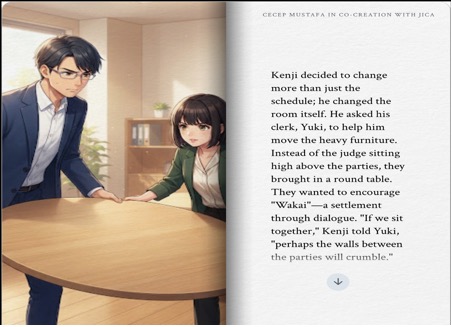
Dedicated preparation rooms were introduced. Courtrooms adopted more collaborative, round-table configurations. The physical environment increasingly reflected a different philosophy of procedure: less fragmented, more concentrated, more communicative.
This is a fascinating relationship between law, institutional practice, and physical space.
We often imagine that law changes institutions.
But institutions can also change law.
And once the law changes, it can change the physical environment in which law is practiced.
The courtroom therefore becomes more than a room.
It becomes a reflection of the procedural philosophy of the judiciary.
A high bench, separated parties, and formal confrontation communicate one idea of justice.
A round table communicates another.
Neither piece of furniture decides a case, of course. But furniture can influence behavior. A room can tell people, even before anyone speaks, whether they are expected to confront one another or to work through a problem together.
Sometimes architecture is procedural law in silent form.
The Judge Who Knows the Case Can Also Help the Parties Settle It
Another feature of the Japanese model is particularly significant.
The judge who conducts the issue structuring and evidence examination is also involved in Wakai.
That continuity matters.

The judge has already listened to the parties. The judge has already examined the evidence. The judge understands where the factual disagreements actually lie and where the legal uncertainty remains.
When that same judge participates in settlement, a proposal is therefore not coming from someone who has merely read the case file.
It comes from someone who has experienced the case procedurally.
This can make a settlement proposal highly persuasive.
There is also a subtle philosophical point here.
Settlement does not necessarily require the judge to know less.
Sometimes, settlement becomes more meaningful precisely because the judge knows enough.
The parties may be more willing to consider compromise when they believe that the person facilitating the discussion understands the strengths and weaknesses of their respective positions.
This creates an interesting balance between judicial neutrality and judicial engagement.
The judge is not simply saying, “You should settle.”

The judge is, in effect, helping the parties understand the realistic terrain on which settlement might be possible.
What Does This Mean for Indonesia?
The Japanese experience raises an important question for Indonesian civil procedure.
Should every case move through the same procedural path?
Perhaps not.
A simple dispute and a technically complex commercial dispute do not necessarily need the same procedural architecture. Yet conventional procedure often treats them as if they do.
One possible response is to institutionalize pre-trial issue triage.
At the first hearing, the judge could classify a case into an appropriate procedural track: a default track, a fast-track trial, fast-track mediation, or intensive pre-trial issue structuring.
The objective is not to create more bureaucracy.
It is to prevent every case from becoming bureaucratic.
Evidence Should Not Take Years to Arrive
A second lesson concerns evidence.
If witnesses are examined only in small fragments, the court can spend enormous amounts of time merely reconstructing the story of the case.
An alternative would be to require parties to submit advanced written witness statements and detailed question lists, allowing oral examination to focus on the points that genuinely require clarification or challenge.
Where appropriate, witness examination could then be concentrated into intensive, single-day sessions.
The principle is straightforward:
prepare more before the hearing so that the hearing itself can become more meaningful.
This is not about rushing justice.
It is about removing unnecessary waiting from justice.
There is a difference.

One Judge, One Procedural Memory
A further reform concerns the relationship between pre-trial management and settlement.
The judge who structures the issues and examines the evidence should, within an appropriate legal framework, also be authorized to conduct evaluative Wakai.
The reason is institutional memory.
A case should not have to repeatedly introduce itself to different procedural actors.
If one judge has developed a clear understanding of the dispute, that accumulated judicial knowledge can become an asset in settlement discussions.
This does not mean that the judge should impose a settlement.
Rather, the judge can use the understanding formed through the proceedings to help the parties see which points are genuinely negotiable and which are unlikely to disappear through compromise.
In this sense, judicial knowledge becomes a bridge to settlement rather than merely a preparation for judgment.
The Courtroom Itself Must Change
Finally, procedural reform cannot be separated from the physical environment of the court.
If we want judges, lawyers, and parties to engage in active oral communication, perhaps we should reconsider the traditional courtroom design.
A courtroom dominated by a high bench naturally emphasizes hierarchy.
A round-table courtroom creates a different visual relationship.
It does not eliminate judicial authority. It simply changes the way that authority is exercised and experienced.
The same principle can apply to dedicated digital pre-trial rooms, where judges and lawyers can review documents, organize evidence, identify disputed issues, and prepare the case before entering the formal hearing stage.
This is where judicial modernization becomes more than digitization.
It becomes a procedural redesign.
From Japan to Indonesia: The Value of Institutional Learning
There is a broader lesson here.
Japan’s experience demonstrates that judicial reform can emerge through a cycle of experimentation, observation, institutional learning, and legal codification.
The frontline judge becomes an innovator.
The institution becomes a learner.
The legislature or rule-maker becomes the formalizer.
And the court building itself eventually becomes part of the reform.
For Indonesia, this suggests that reform should not always begin by asking, “What new rule should we write?”

Sometimes the better question is:
“What are judges already doing that works, and why?”
From there, the task is to identify practices that can be tested, measured, refined, and eventually institutionalized.
Of course, not every Japanese innovation should simply be transplanted into Indonesia. Legal culture, institutional structures, caseloads, professional roles, and procedural traditions are different.

But the principle of bottom-up institutional learning is widely relevant.
The most sustainable reforms may be those that do not treat judges merely as recipients of policy.
They treat judges as sources of institutional knowledge.
And perhaps that is the deeper lesson I take from observing Japan.
Judicial reform does not always arrive from above.
Sometimes it begins quietly in a courtroom, with a judge who decides that two and a half years is too long, that five minutes is not enough, and that there must be a better way.
When that small experiment proves capable of producing better justice, the next task is not to admire it.

The next task is to learn from it.
Then to institutionalize it.
And eventually, to redesign the system around it.
That is how a practical innovation becomes a legal reform.
And that is how a courtroom experiment can, over time, become a transformation of the judiciary itself.

Untuk Mendapatkan Berita Terbaru Suara BSDK, Follow Channel WhatsApp: SUARABSDKMARI